Global Worming

|
Left Side Bar
|
Latest UpdateDate posted Jun 6, 2018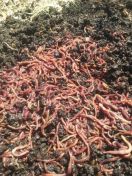 My adventures as an apprentice Worm Man (1)I have 100kg of organic waste in the boot of my car by David Jockel
Well, it’s been quite a few months since I first started working for Global Worming. Cid is away this week, so rather than using our normal transport system I find myself with 100kg of organic waste in the boot of my car. This material is two days of waste from one average office building in Canberra. 100kg may not sound like a lot, but when you see it crammed into your boot I can assure you it is quite tangible. And it’s not difficult to extrapolate from this. How many office buildings are there in Canberra? How many office buildings are there in Sydney? How many office buildings are there in Australia? How many office building are there in the world? (These are not purely rhetorical questions. I actually Googled ‘how many office buildings are there in the world’. I did not find an answer, but I did find estimates for USA varying from one to five million office buildings in that country. So in the whole world? 100 million? 200 million? Whatever the number, we can be sure that it is growing all the time at an incredible pace.) And remember, the stuff filling up my boot is just two days’ worth of waste. Day after day, week after week, year after year, in office buildings all over the world, the organic waste keeps on coming. Billions and billions of kilos. Traditionally, this waste has gone to landfill. It gets dumped into big piles of toxic garbage where it serves no useful purpose, and in fact instead is left to rot and release gasses that, if scientific evidence is to be believed, contributes in a major way to the destruction of the ozone layer. Usually though, when we are working in an office, the removal of waste seems rather abstract. You put your scraps into a neat and tidy garbage bin, and they disappear. People come in after-hours and take them away somewhere. The whole world of waste and cleaners and garbage trucks is quite alien, and let’s face it, somehow distasteful . Sometimes if you are working late the cleaners might start to appear, and you might pretend to be friendly with them. But that is about the limit of contact most office workers have with the shadowy after-hours world of waste removal. Most office workers certainly don’t find the boot of their car filled up with 100kg of food scraps. In the same way, most of us have very little contact with where our food actually comes from in the first place. Of course we know it comes from farms, and many of us have also heard something about the problem of soil degradation. But how many of us have actually seen this ‘degraded’ soil, or the chemicals that are added to it? I haven’t, but I have recently seen and touched something that could surely be part of the solution. A beautiful rich black soil-like substance, teeming with nutrients and life: vermicasts. The phrase ‘teeming with life’ is more than just a warm-sounding cliché. A while ago I asked Cid what the problem was with adding chemicals to the soil to help crops grow. I have no ideological attachment to all things ‘green’ and ‘organic’. If anything, I find something slightly repulsive about these words, and their sometimes holier-than-thou disciples. So I wondered, if adding chemicals works, why not do it? As far as I know, there is nothing inherently bad or evil about ‘chemicals’. Cid explained the problem succinctly. Healthy soil, in which plants like to grow for generation after generation, is, in fact, ‘teeming with One of the problems with adding chemicals to the soil (after the plants that have been grown in the soil have all been removed) is that the chemicals do not replace these microorganisms. Over time, the soil changes from being a vibrant and complex ecosystem into something sterile and devoid of life. So farmers must keep adding more and more chemicals, which are increasingly becoming rarer and more expensive. Furthermore, it doesn’t seem unreasonable to be concerned about what effect being grown in an artificial, lifeless environment has on the plants themselves. And what effect eating these plants has on our own living bodies. A healthy human digestive system , in common with healthy soil, is apparently also host to millions of microorganisms. I recently signed up as a member of the Canberra Organic Growers society. This, given the suspicions I have already mentioned about the increasingly trendy organic movement, was something of a big step. Everywhere you turn some product seems to be boasting that it is ‘organic’ or ‘green’ or ‘eco-friendly’. But I had met a couple of COGS members and was impressed that they seemed like sensible people, not card-carrying ideologues or opportunistic marketeers at all. And I was particularly struck by the simple description on their website of what organic growing boiled down to: putting back into the soil what we take from it. But what, in current reality, happens to most of the stuff we take from the soil? Obviously some of it gets eaten. And the problem of our failure to recycle our bodies and the organic material they excrete over a lifetime is clearly something we need to address. But apart from what we eat, there is, as I mentioned above, the small matter of the billions of kilos of organic ‘waste’ in the boot of my car. Or more accurately, the billions of kilos of organic waste that is not in the boot of my car. The billions of kilos of organic waste (not just from office buildings but from houses and apartments and restaurants and shopping malls and supermarkets) that is instead rotting in garbage dumps all over the word, releasing energy and gasses in ways that destroy rather than nurture the life we enjoy. Will we have enough sense to take that organic material and put it back into the soil? It’s really not that difficult to do or to understand. I’m a barely functioning flabby 49 year old wreck of a man, and even I am able to lug a bit of food around for the worms from time to time. And furthermore, and keep this to yourselves, last night I was in secret teleconference with the Worm and Microorganism Collective Consciousness Alliance and was informed that solving the organic waste problem will probably be enough to finally stop the Great Wheel of Destiny from continuing to grind onwards in its current Vicious Circle, and instead start it slowly moving in the opposite direction: the Sympatico Circle. Quinn the Eskimo will arrive, soldiers will tear off their uniforms, and we can all start jumping for joy and having pleasant naps whenever and wherever we feel like it. 
Global worming and schoolsDate posted Jul 7, 2018Global worming has embarked on an exciting collaborative project with many schools in NSW and Canberra. Organic waste is being collected from classrooms, staffrooms and the canteen and recycled into an organic fertiliser using worms. While for most schools the organic waste is being collected and transferred offsite to Global worming farms, there are seven schools processing all organic waste on site using worm farms set up and managed by Global worming. Onsite management of organic waste is achieved with several models with the most popular being a leased farm arrangement. With the support of the ACTSMART school program, Global worming has also established host schools whereby all organic waste from the school along with 2-3 nearby schools is being composted within the school grounds using worms. Two trial host school operations are being evaluated by the ACT government over a 12 month period. All worm farms have been established using the same design as that created by Global worming. These worm farms are modular and able to be expanded as required. For a typical school the farms are 6 metres long and 1.8 metres wide. More info...
My adventures as an apprentice Worm Man (2)Date posted Jun 7, 2018
Journey to the Centre of a Clod of Earth More info...
My adventures as an apprentice Worm Man (1)Date posted Jun 6, 2018
I have 100kg of organic waste in the boot of my car More info... |
Facts about Organic WasteLorem ipsum dolor sit amet, consectetur adipiscing elit. Proin quis sem magna, eu pulvinar nisl. Ut ultrices iaculis tortor porta molestie. Morbi odio tellus, dapibus eget rutrum ac, lacinia vitae augue. Phasellus dictum massa vitae lorem fermentum semper. Etiam nec dolor ac elit euismod consequat eget sed magna. Vestibulum ultrices dolor at mauris lacinia vestibulum. Curabitur consectetur aliquam porttitor. Australians are throwing away food worth $5.2 billion a year, with the average household wasting $616 of food a year. Australians waste close to 3 million tonnes of food per annum, or 136 kilos per person per annum. |