Global Worming

|
Left Side Bar
|
Waste auditing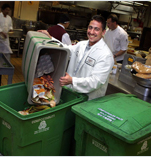
Waste auditingOne of the key environmental impacts of an organisation is from waste that is generated within the office. Conducting a waste audit is an important way of determining how much waste is generated by an organisation and assessing staff waste disposal behaviour. A waste audit enables issues to be identified and ultimately improve on current waste disposal practices.
A waste audit generally involves the measurement of the streams of waste that is produced by an organisation. Most organisations have several waste streams that may include a combination of - general waste - recyclable waste - organic waste - paper towels - paper and cardboard
The audit quantifies the waste streams by weight and volume and also quantifies contamination levels in each waste stream.
Waste audit process and methodology An audit is usually conducted over a ‘typical week’ so that daily statistics can be compared. A typical week is one that does not have a large number of staff away due to public holidays, school holidays or an event (such as a conference).
All waste collected by cleaners and contractors is left at a central point. This central point should be clear of hazards and in close proximity to waste disposal stations (ie hoppers and skips) where the waste is disposed off following the audit. Underground car parks and loading docks are example of appropriate places to conduct an audit.
A double entry recording system is used where all waste is weighed by stream prior to sorting and following sorting. After the initial weighing, each bag of waste is emptied onto a thick plastic sheet within a trailer which is raised to ensure no liquid waste is lost during the process. The waste is sorted by hand and placed in 120 litre and 240 litre wheelie bins and 20 litre buckets for weighing and estimation of volume. Following the sorting the bins with the sorted waste are individually weighed and the weight of the empty bin subtracted from the total weight (tare weight). Volume is estimated after minimal manual compaction of the waste (or ‘natural compaction’).
Image: Auditing the recycling waste stream
Reporting of waste audit results For each day of the audit the following statistics are collated: - Waste collected by stream (weight) - Waste audited by stream (weight and volume) following the sorting of waste and reallocation to the correct stream for disposal
Results from the waste audit are available in electronic form. A report is provided as an electronic word document. The report also includes a copy of the raw audit data from each audit, in an electronic Excel document. A table shell of audit results follows and an outline of the Waste audit report is attached (see Attachment 1). |
Facts about Organic WasteLorem ipsum dolor sit amet, consectetur adipiscing elit. Proin quis sem magna, eu pulvinar nisl. Ut ultrices iaculis tortor porta molestie. Morbi odio tellus, dapibus eget rutrum ac, lacinia vitae augue. Phasellus dictum massa vitae lorem fermentum semper. Etiam nec dolor ac elit euismod consequat eget sed magna. Vestibulum ultrices dolor at mauris lacinia vestibulum. Curabitur consectetur aliquam porttitor. Australians are throwing away food worth $5.2 billion a year, with the average household wasting $616 of food a year. Australians waste close to 3 million tonnes of food per annum, or 136 kilos per person per annum. |